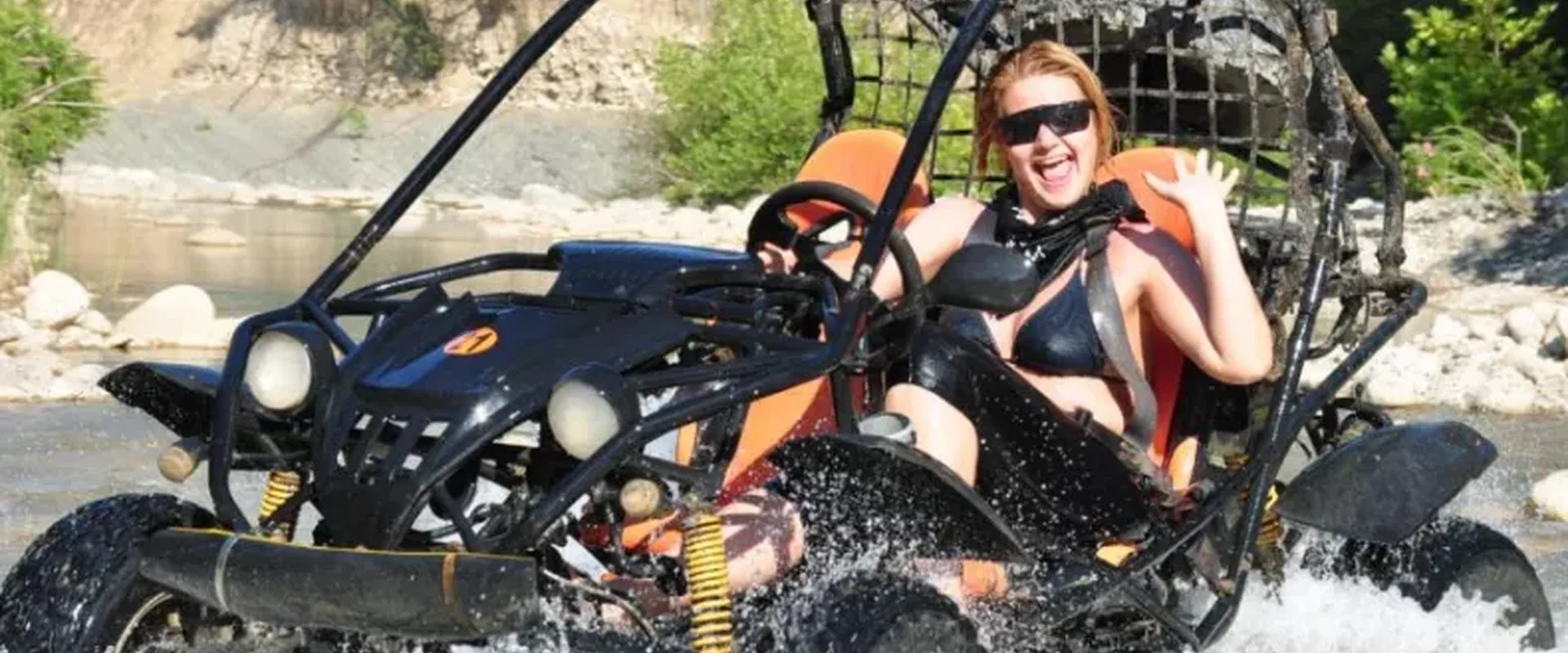
Buggy safety gear works as a layered system, not a single lucky object: the steel roll cage keeps a protected space around you, the seatbelts keep your body inside that space when the ground throws the vehicle around, and the helmet and goggles handle everything that flies at your head and eyes. On top of the hardware sits the human layer — a full safety briefing, a practice lap, and a professional off-road guide who leads the convoy and sets its pace — plus accident insurance included in every tour we run from Side, Antalya, Belek, Alanya and Kemer.
A buggy is a two-seat side-by-side: you sit in it rather than on it, you steer with a car-style steering wheel, and you drive with a throttle pedal and a brake pedal. That single design decision is why the safety story is different from anything with handlebars — the protective structure travels with you instead of being strapped to you.
What the steel roll cage actually does
The cage is the welded steel frame that surrounds the two seats, above and beside you. Its job is to preserve survivable space. If a buggy tips onto its side on a rutted slope — the most common off-road mishap anywhere in the world, ours included — the cage takes the load and the cabin keeps its shape, so the occupants are not what meets the ground.
A cage only works if you stay inside it. That means arms and legs in, hands on the wheel, no reaching out for a photo, no bracing a hand against the ground if the vehicle leans. Every briefing hammers this point because it is the one instruction that turns the frame from decoration into protection.
Why seatbelts matter more on uneven ground than on a road
On tarmac, a seatbelt mostly matters in a collision. On a forest track it matters constantly. Ruts, dips, loose stones and shallow river crossings move the vehicle vertically and sideways many times a minute, and an unbelted body moves out of phase with the seat — you get bounced, you lose the pedals, and you lose fine control of the wheel exactly when you need it.
- They keep you in the protected zone that the roll cage defines.
- They keep you in contact with the controls, so steering and braking inputs stay accurate over rough sections.
- They reduce fatigue — being held in the seat is far less tiring than fighting to stay in it.
- They protect the passenger too, including a child riding in the second seat, whose age we confirm at booking.
Belts are checked before the convoy departs, and re-checked if the group stops. This is not paperwork; it is the single highest-value thirty seconds of the day.
Helmets and goggles: dust, branches and the things you cannot dodge
The Taurus foothill trails are dry and dusty in summer and muddy after rain, and buggies travel in a convoy. That means the air in front of you is not always clear. Goggles seal around the eyes so grit and spray do not force you to blink or look away mid-corner — a driver who cannot see is a driver who cannot steer. On narrow forest sections, low branches sit at exactly head height, and a helmet turns a nasty scratch into a knock you laugh about later.
Wear both properly: helmet strap snug under the chin, goggles over the helmet strap and against the face, not pushed up on the forehead "just for the dusty bit". Gear worn wrong is gear that isn't there.
The guide, the briefing and the honest risk picture
Off-road driving in a canyon landscape is not risk-free, and anyone who tells you otherwise is selling something. The real risks are simple: tipping on a slope, hitting a rut too fast, following the vehicle in front too closely in dust, and overconfidence in the last thirty minutes when everyone feels like a rally driver.
Each of those is managed the same way — by pace. A professional off-road guide leads every convoy, sets the speed to the slowest, most cautious driver in the group, signals hazards ahead, and stops the group where the terrain demands it. Before departure you get a full safety briefing and a practice lap on easy ground, so the first time you touch the throttle is not the first time you meet a rut. No driving licence and no experience are needed, but the driver must be an adult, and ability decides the seat: anyone who does not feel confident rides as a passenger for exactly the same money. Accident insurance is included as the final layer, behind all the others.
Quick pre-departure checklist
- Helmet on and strapped; goggles sealed against the face.
- Seatbelt fastened for driver and passenger.
- Limbs inside the cage at all times.
- Keep a clear gap to the buggy ahead — dust hides ruts.
- Follow the guide's line and pace; if something feels wrong, stop and wave.
- Wear clothes and closed shoes you are happy to get muddy.
Ready to ride? Reserve your buggy safari free online in a minute — no prepayment, you pay the guide on tour day by cash or card, with free door-to-door hotel transfer from Side, Manavgat, Boğazkent, Belek, Alanya, Kemer and the Side resorts. Any question about the gear, the terrain or who should drive, message us on WhatsApp — we answer 24/7.