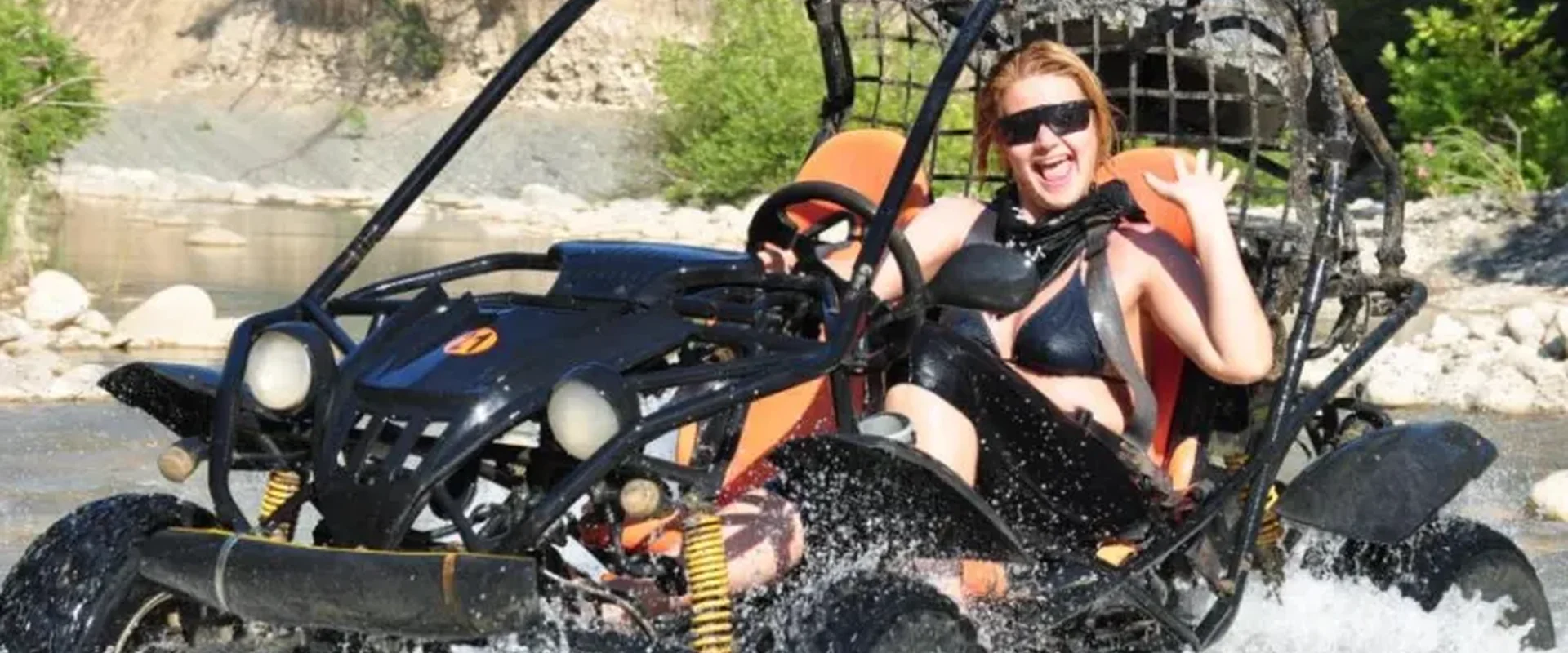
The buggy safety briefing is a short, hands-on session held at the off-road base before every convoy leaves: you are given a helmet and goggles, shown the handful of controls a side-by-side buggy actually uses, taught the convoy rules and hand signals, and then sent out on a practice lap while the guide watches you drive. Nothing starts on the real trail until the guide is satisfied that every driver in the group has understood it — which is exactly why first-timers stop being nervous roughly ten minutes into it.
Most people arrive at a buggy safari having never driven anything off-road. That is normal here. No driving licence and no previous experience are needed — the briefing exists precisely because the group is assumed to be starting from zero. Here is what happens, in order, so nothing on the day is a surprise.
Step 1: Gear handout and fitting
After your free door-to-door hotel transfer drops you at the base, the first thing that happens is kit. A team member hands out helmets and goggles and checks the fit — a loose helmet or goggles sitting badly is the single most common comfort problem on a dusty trail, and it is fixed in thirty seconds at this stage rather than halfway up a hill.
- Helmet — fitted and checked, worn from the practice lap onwards.
- Goggles — for dust, mud spray and water crossings.
- Accident insurance — included in the tour, explained at this point.
- Clothing check — closed shoes and clothes you do not mind getting muddy; you will get dirty, and that is the point.
Step 2: The controls demo
This is the part that surprises people most, because there is so little to learn. A buggy is a two-seat side-by-side vehicle: you sit in it like a car, behind a car-style steering wheel, inside a steel roll cage, with seatbelts on. The controls are deliberately simple — a throttle pedal, a brake pedal, and the wheel. There is no gear-changing drama to master.
The guide demonstrates it seated in a buggy while the group stands around, then invites people to sit in and put their hands and feet where they belong. Steering, braking, how the machine behaves when you lift off the throttle, and how to sit properly with the belt fastened are all covered here. Questions are welcome at this stage — asking one now is far better than guessing later.
Step 3: Convoy rules, spacing and signals
A buggy safari is not a race and it is not free-roaming. Everyone travels in a convoy led by a professional off-road guide who sets the pace to the group — meaning the pace is set by the least confident driver, not the most eager one. The briefing covers how that convoy works:
- Stay in line — you follow the vehicle in front and never overtake the lead guide.
- Keep your spacing — leave a big enough gap that you are out of the dust cloud of the buggy ahead and can see the track.
- Watch the guide — he demonstrates the exact hand signals he will use that day for slowing, stopping and hazards ahead, and you practise reading them.
- If you stop, stop safely — where to pull up, and how the group regroups so nobody is left behind.
Step 4: Water crossings and what the terrain will throw at you
The trails around the Taurus foothills and canyon country mix dry dust, deep mud, forest tracks and shallow water crossings. The briefing tells you how to approach each one: steady and controlled through water rather than fast, why you follow the exact line the guide takes, and what to expect when the surface changes from packed dirt to mud. Nothing here requires skill you do not already have from driving a car — it requires listening.
Step 5: The practice lap and the final go/no-go check
Before the convoy departs, every driver takes a practice lap on a controlled section near the base. This is the real test, and it works in both directions: you find out how the buggy feels, and the guide quietly watches how you handle it.
If someone is clearly uncomfortable, the fix is easy and carries no penalty. Ability decides who drives, not paperwork — a driver who would rather not drive simply takes the second seat as a passenger for exactly the same money, and a confident partner or friend takes the wheel. Only when the guide has seen every driver control the machine, and has confirmed helmets, goggles and belts across the group, does the convoy roll out onto the trail.
That is the whole briefing — and it is why first-timers who arrive nervous are usually grinning by the first water crossing. Reserve your buggy safari online free of charge, pay the guide on the day in cash or by card, and message us any time on WhatsApp 24/7 if you want to talk through the briefing, the transfer or who should drive before you book.