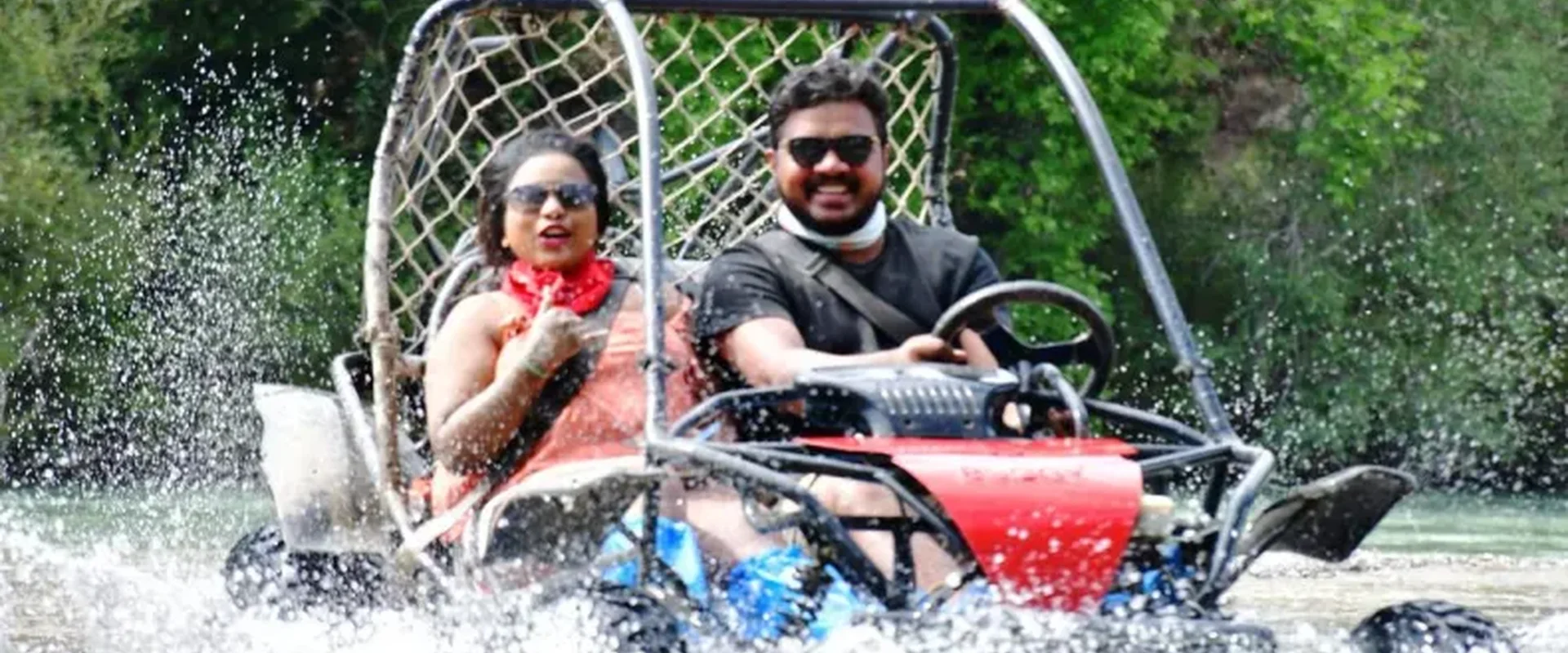
Driving a buggy is closer to driving an automatic car than to riding a motorbike: you sit in a seat, hold a round steering wheel, press the right pedal to go and the left pedal to stop. Your first ten minutes are not on the trail at all — they are a safety briefing and a supervised practice lap on flat ground, and by the end of that lap almost every first-timer is grinning and asking when the convoy leaves.
You do not need a driving licence and you do not need off-road experience to drive one of our buggies in the Side and Antalya region. The only firm rule is that the driver must be an adult. Ability decides the rest: if you take the practice lap and decide you'd rather not drive, you ride in the second seat for exactly the same money, and nobody makes a fuss about it.
The controls: three things to remember
A buggy is a two-seat side-by-side vehicle with a steel roll cage, seatbelts for both people, and car-style controls. There is no clutch to worry about and no gear stick to learn. Here is the whole system:
- Steering wheel — same as a car. Hold it with both hands at the sides, thumbs on the outside of the rim, not hooked around the spokes. On rough ground the wheel can kick, and hands placed properly simply ride it out.
- Right pedal — throttle. Press gently and progressively. On loose surfaces, smooth pressure gives you grip; stamping gives you wheelspin.
- Left pedal — brake. Brake in a straight line, before the corner, not in the middle of it. Squeeze rather than stab.
Add your helmet, goggles and seatbelt and you have everything you'll touch for the next few hours. Your guide will walk both seats through it in your own words before anyone moves.
The practice lap: what actually happens
Before the convoy departs, every driver takes a practice lap in a controlled area with the guides watching. This is where the theory becomes muscle memory. You'll get a feel for how much throttle is "enough", how quickly the brakes bite, and how wide the buggy needs for a turn — it is wider than it feels from the driver's seat.
Use this lap properly. Try one deliberately hard stop so you know the brakes. Take one corner slower than you think you need to, and one at a comfortable pace, so you can feel the difference. Ask the guide anything, even if it feels obvious — these are the same questions that come up on every buggy safari for complete beginners. Nobody has ever been judged for asking which pedal is which.
If you're driving with a partner, friend or child in the second seat, this is also the moment to agree who does what: the passenger holds on and enjoys the ride, the driver drives. Child passengers are confirmed at booking.
How the convoy works
You never drive alone and you never navigate. A professional off-road guide leads the convoy and sets the pace for the group, and there is support behind. Your job is to follow the vehicle in front and watch the guide.
The essential hand signals are demonstrated in the briefing and are deliberately simple: an arm raised or a flat palm means slow down or stop; a hand waved forward means keep moving; a hand pointing to one side means obstacle — go that way. If you're ever unsure what a signal meant, slow down. Slowing down is never the wrong answer.
Dust, distance and water
Dust is the one thing that surprises first-timers. On dry forest tracks the buggy ahead throws up a cloud, and the fix is spacing: hang back far enough that you can always see clear track ahead of you, not just a brown wall. If you can't see, ease off and let the air clear. Your goggles stay on, always — that is what they're for.
Shallow river and water crossings look dramatic and are the easy part. Enter straight, keep a steady throttle, don't brake mid-crossing, and let the buggy carry you through. Mud is the same principle: momentum and a straight wheel beat sudden inputs.
Cornering on loose ground — and what not to do
On gravel, sand and dry dirt the buggy will move around under you. That's normal, and the technique is the same one rally drivers use: slow in, gentle out. Brake before the turn, look where you want to go, then feed the throttle back in as the wheel straightens.
The short list of things that spoil a ride:
- Overtaking the guide, or overtaking anyone in the convoy.
- Tailgating in dust so you can't see what the track is doing.
- Braking hard in the middle of a corner.
- Steering with one hand, or holding the wheel from the inside.
- Ignoring a signal because you assume it wasn't meant for you.
- Unbuckling, standing up, or taking off the helmet while the convoy is moving.
Everyone in the group wears a helmet and goggles, accident insurance is part of what the tour includes, and the guides adjust the pace to the slowest comfortable driver — not the fastest. Quad (ATV) safaris are the alternative if you'd rather ride solo on a machine you straddle like a bike; the buggy is the better call when two people want to share one vehicle and stay side by side, and when a car-style seat and roll cage feel more reassuring.
Ready to take that first practice lap? Reserve your buggy safari in Side online for free — no card, no prepayment — and pay the guide on the day in cash or by card. Free door-to-door hotel transfer is included from Side, Manavgat, Boğazkent, Belek, Alanya (Türkler, Okurcalar, Avsallar) and Kemer, and our team is on WhatsApp 24/7 if you'd like to ask anything before you book.